Airjet and Waterjet Loom Machines in Surat: Manufacturer, Supplier & Complete Buying Guide
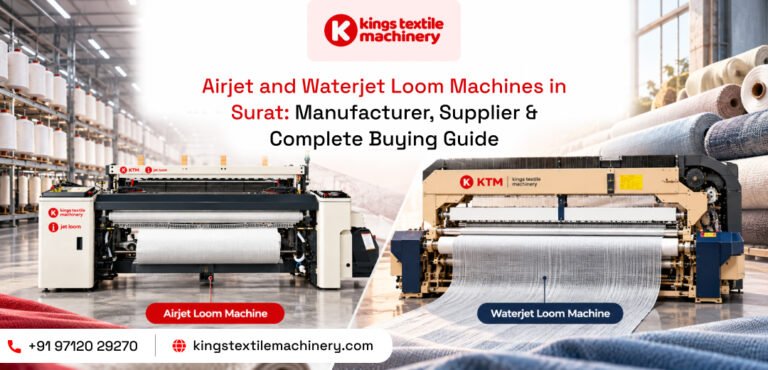
Compare Airjet and Waterjet Loom Machines in Surat, including prices, manufacturers, suppliers, features, selection tips,...

Find the right Textile Machinery Dealer And Supplier in Surat with this complete buying guide covering prices, Airjet Looms, Waterjet Looms, selection, support and maintenance.
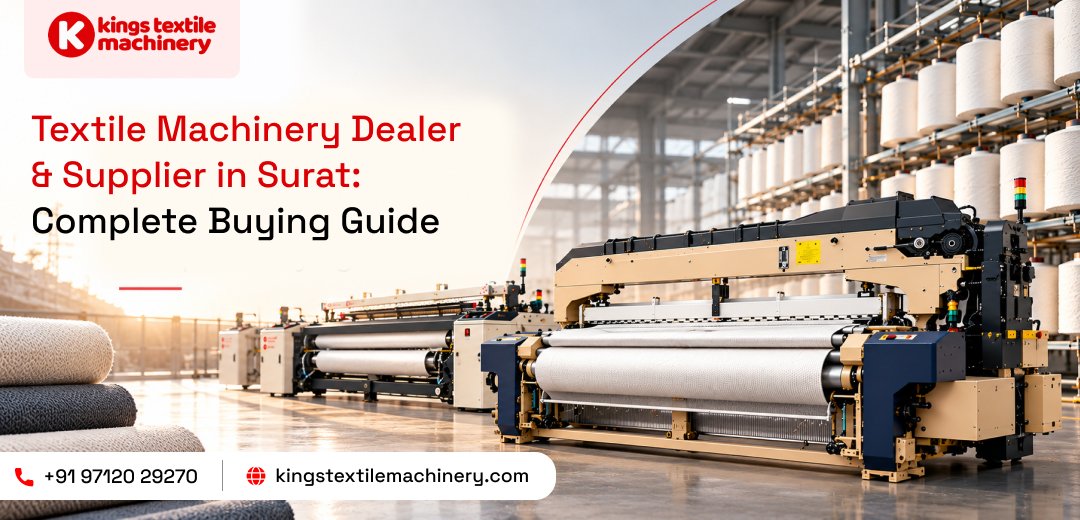
Surat is one of India’s major textile manufacturing and trading hubs, with a large ecosystem of textile manufacturers, weaving units, fabric producers, processors, traders, and growing textile businesses. With this strong manufacturing base, the demand for reliable Textile Machinery Dealer And Supplier in Surat continues to grow.
Choosing the right textile machinery is an important decision for any textile business. The machine needs to match the fabric, yarn, production capacity, factory setup, and long-term business requirements.
At the same time, selecting the right machinery dealer or supplier is equally important. A reliable supplier can provide more than machinery. Businesses may also need consultation, installation, commissioning, technical support, maintenance, and spare parts.
This guide explains what textile businesses in Surat should consider before choosing a Textile Machinery Dealer And Supplier in Surat.
Surat has a strong textile manufacturing ecosystem, particularly around woven fabrics, synthetic textiles, textile processing, and related manufacturing activities.
The city’s textile businesses range from smaller weaving units to large-scale manufacturing operations. As production requirements change, businesses may need new machinery for:
Because different businesses have different requirements, choosing machinery based only on price can create problems later.
A better approach is to evaluate the machine, supplier, technical support, maintenance requirements, and total cost of ownership together.
A Textile Machinery Dealer And Supplier helps businesses source textile machinery and related equipment according to their production requirements.
Depending on the supplier and project, services may include:
For businesses in Surat, working with a supplier familiar with textile manufacturing requirements can make the machinery purchasing process more straightforward.
The right machine depends on your production application. Some common weaving machinery categories include:
Airjet Looms use air to insert the weft yarn across the warp. They can be suitable for high-speed weaving applications where the fabric and yarn characteristics are compatible.
Businesses considering an Airjet Loom should evaluate:
Waterjet Looms use water for weft insertion and can be suitable for specific fabric and yarn applications.
Before purchasing a Waterjet Loom, businesses should consider:
Depending on the production requirement, textile businesses may also evaluate other types of weaving machinery.
The important point is to choose machinery according to the actual production application rather than selecting a machine simply because it is widely used.
Finding a machinery dealer is easy. Finding the right dealer for your specific production requirement requires more research.
Consider these factors before making a decision.
Look at the supplier’s experience in textile machinery and whether they understand the requirements of textile manufacturers and weaving businesses.
An experienced supplier can help you evaluate machinery beyond basic specifications.
Check whether the supplier provides the type of machinery you actually need.
For example, if you are looking for weaving machinery, ask whether they can provide suitable Airjet Loom or Waterjet Loom options.
The supplier should be able to explain important machine specifications and how they relate to your production application.
Technical knowledge is particularly important when comparing different machines.
Ask what happens after the machine is purchased.
Installation and setup can be important parts of a machinery project, particularly for new factories or production expansion.
Ask whether commissioning and testing support is available and what the scope includes.
Proper commissioning can help prepare machinery for production according to the applicable machine requirements.
Production teams may need technical guidance after the machine is installed.
Ask about the supplier’s technical support process and how machinery-related concerns are handled.
Maintenance is an important part of managing textile machinery over its operating life.
Ask whether the supplier can discuss preventive maintenance, troubleshooting, and other maintenance requirements.
Before buying machinery, ask about spare parts.
Find out:
A reliable spare-parts supply can make machinery maintenance easier.
Setting up a new textile manufacturing facility requires careful planning.
Before purchasing machinery, define your production requirements.
What type of fabric will you manufacture?
What yarn type and characteristics will your production require?
What working width do you need?
How much fabric do you plan to produce?
What space, utilities, and operating conditions are available?
Will you add more machines in the future?
Once these requirements are clear, you can approach a Textile Machinery Supplier in Surat with a more specific machinery requirement.
Existing textile businesses may need additional machines when production demand increases.
However, adding machinery is not simply a matter of purchasing another machine.
Consider:
The right machinery should complement your existing production setup wherever applicable.
If you are searching for an Airjet Loom Dealer And Supplier in Surat, start by defining your production requirements before requesting a quotation.
Important considerations include:
Airjet Looms can provide high-speed weaving capabilities for suitable applications, but the machine should be selected according to the specific fabric and production requirement.
Kings Textile Machinery can discuss Airjet Loom requirements for textile businesses in Surat and across India.
Businesses looking for a Waterjet Loom Dealer And Supplier in Surat should evaluate the machine based on their fabric, yarn, production requirements, and available infrastructure.
Waterjet Looms use water for weft insertion and can be suitable for specific applications.
Before purchasing, consider:
A machinery supplier should help you understand these considerations before finalizing the machine.
One of the most common questions for textile manufacturers is whether they should choose an Airjet Loom or Waterjet Loom.
| Factor | Airjet Loom | Waterjet Loom |
| Weft insertion | Air | Water |
| Application | Depends on fabric and yarn | Depends on fabric and yarn |
| Utility | Compressed air | Water-related infrastructure |
| Production | Suitable high-speed applications | Suitable high-speed applications |
| Selection | Production-specific | Production-specific |
There is no universal answer.
The better option depends on your fabric, yarn, production target, machine configuration, factory infrastructure, and business objectives.
If you are unsure which technology is suitable, consulting a textile machinery expert before purchasing can help.
The price of textile machinery can vary significantly depending on:
Therefore, there is no single price that applies to every textile machine.
Instead of searching only for the cheapest machinery, evaluate the total cost of ownership.
This can include:
A machine with a lower purchase price may not necessarily be the most economical option over the long term.
Kings Textile Machinery supports textile manufacturers and weaving businesses looking for reliable machinery solutions.
With 12+ years of experience and 200+ clients, Kings Textile Machinery provides solutions for businesses evaluating textile machinery for new factories, production expansion, machinery replacement, and ongoing production requirements.
Our solutions include:
We focus on understanding the production requirement before discussing the appropriate machinery solution.
Whether you are based in Surat or another part of India, our team can discuss your textile machinery requirements.
Follow these steps before finalizing your purchase.
Identify your fabric, yarn, width, production capacity, and application.
Compare machines based on specifications and suitability.
Look at experience, support, installation, maintenance, and spare-parts capabilities.
Ask for detailed quotations rather than comparing only headline prices.
Consider installation, utilities, maintenance, spare parts, and operating costs.
Understand the technical and after-sales support available.
Select the machinery and supplier that best match your production and long-term business requirements.
Choosing a Textile Machinery Dealer And Supplier in Surat is an important decision for textile manufacturers, weaving mills, and fabric producers.
The right supplier should offer more than machinery. You should also consider technical knowledge, machine selection, installation, commissioning, maintenance, spare parts, and ongoing support.
Whether you are setting up a new textile unit, expanding your existing production, replacing machinery, or evaluating Airjet and Waterjet Looms, take the time to understand your requirements before making an investment.
Kings Textile Machinery provides textile machinery solutions for businesses in Surat and across India, backed by 12+ years of experience and 200+ clients.
Looking for a Textile Machinery Dealer And Supplier in Surat? Contact Kings Textile Machinery to discuss your machinery requirement and get a suitable quotation.
Start by defining your production requirements, including fabric type, yarn, fabric width, production capacity, and application. Then evaluate dealers based on machinery range, industry experience, technical knowledge, installation support, commissioning, maintenance, spare parts, and after-sales assistance. Don’t compare suppliers only on machine price. A supplier that understands your production requirements and can support the machinery after purchase may provide greater long-term value. Request detailed quotations and compare the complete investment before making your final decision.
The appropriate machinery depends on the type of textile production. Surat has a broad textile ecosystem, including weaving and fabric manufacturing businesses. For weaving applications, businesses may consider Airjet Looms, Waterjet Looms, and other weaving machines depending on their fabric and yarn requirements. The best machinery depends on production capacity, fabric specifications, yarn characteristics, machine configuration, factory infrastructure, and investment objectives. A textile machinery supplier can help evaluate these factors before recommending a suitable machine.
Textile machinery prices vary depending on the machine type, model, specifications, working width, production capability, configuration, automation, manufacturer, and other project requirements. Installation, utilities, maintenance, spare parts, and technical support can also affect the total investment. Because of these variables, a general online price may not accurately represent the cost of the machine you need. It is better to provide your specific production requirements to a supplier and request a detailed quotation.
You can find Airjet Loom dealers and suppliers by researching textile machinery companies that specialize in weaving equipment and then comparing their machinery, experience, support, and services. When evaluating an Airjet Loom supplier, consider machine specifications, fabric applications, production capacity, installation, technical support, maintenance, and spare-parts availability. Kings Textile Machinery can discuss Airjet Loom requirements for businesses in Surat and other parts of India based on their specific production needs.
Neither Airjet Looms nor Waterjet Looms are universally better. The appropriate machine depends on the fabric, yarn characteristics, production requirements, machine configuration, and factory infrastructure. Airjet Looms use air for weft insertion, while Waterjet Looms use water. Each technology has different operating considerations. Textile manufacturers should evaluate the machines according to their specific production application rather than choosing based only on machine speed or price. A machinery consultation can help you compare the two technologies for your specific requirement.
Installation support depends on the supplier and project scope. Professional machinery suppliers may provide or coordinate installation, setup, commissioning, and testing according to the machine and applicable technical requirements. Before purchasing, ask exactly what installation support is included and what additional services may be required. Proper installation should follow the manufacturer’s technical documentation and safety requirements. Kings Textile Machinery can discuss installation requirements for textile machinery projects based on the machine and project scope.
Textile machinery spare-parts availability depends on the machine, model, component, specification, and supplier. When requesting a spare part, provide the exact machine model, part number if available, component name, photograph, required quantity, and technical specifications. This information can make identification easier. Spare parts may be required for preventive maintenance, servicing, repairs, or replacement of worn components. Kings Textile Machinery can discuss textile machinery spare-parts requirements based on the machine and specific component needed.
Yes, Kings Textile Machinery works with textile businesses in Surat and across India for textile machinery requirements. The company provides solutions covering Airjet Looms, Waterjet Looms, textile machinery consultation, supply, installation, commissioning and testing, technical support, maintenance, and spare parts, depending on the specific project. With 12+ years of experience and 200+ clients, Kings Textile Machinery can discuss your production requirements and help you evaluate a suitable machinery solution.
Before purchasing textile machinery, consider your fabric type, yarn characteristics, required fabric width, production capacity, factory infrastructure, utilities, machine configuration, investment, maintenance, spare parts, installation, technical support, and future expansion plans. You should also evaluate the supplier’s experience and after-sales support. Buying a machine based only on price can create challenges later if the equipment does not match your production requirements. A complete evaluation helps you make a more informed machinery investment.
Yes, textile manufacturers and weaving businesses can seek machinery consultation before purchasing equipment. A consultation can help you understand machinery options based on your fabric, yarn, production capacity, factory setup, and investment requirements. Kings Textile Machinery provides textile machinery consultation for businesses evaluating Airjet Looms, Waterjet Looms, and other weaving requirements. Sharing your production details before the consultation can help the discussion focus on machinery that is relevant to your actual business requirements.
 Oct 08, 2026
Compare Airjet and Waterjet Loom Machines in Surat, including prices, manufacturers, suppliers, features, selection tips,...
 Jul 17, 2026
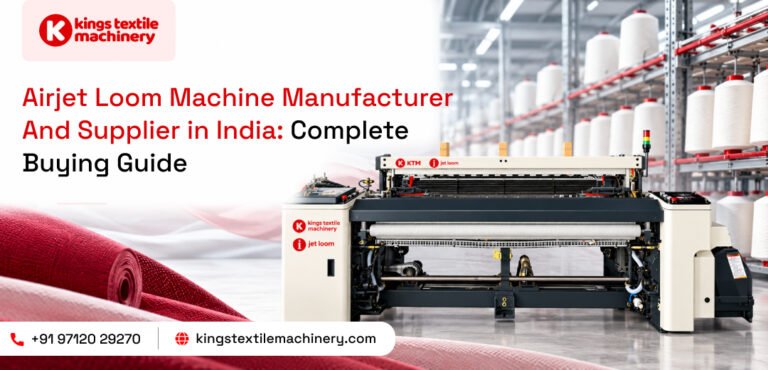
Learn how to choose an Airjet Loom Machine Manufacturer And Supplier in India, including machine...
 Jul 17, 2026
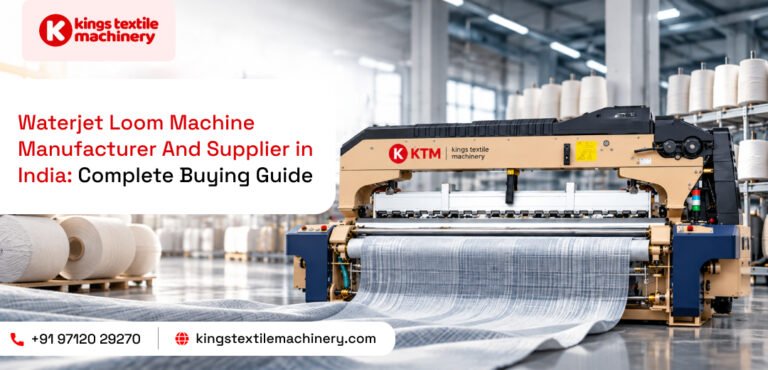
Learn how to choose a Waterjet Loom Machine Manufacturer And Supplier in India, including machine...
 Jul 17, 2026
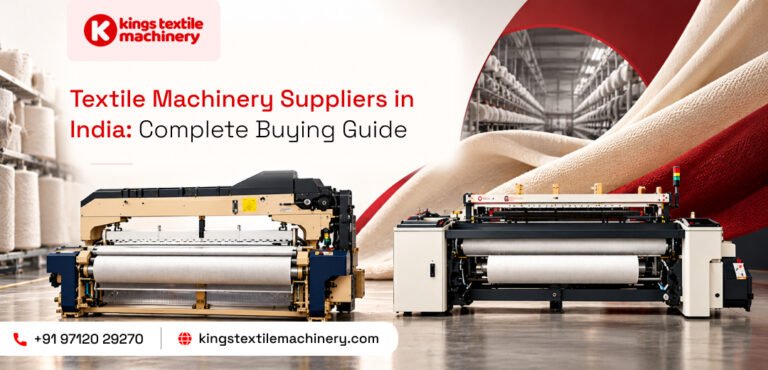
Find reliable Textile Machinery Suppliers in India with this complete buying guide covering machine types,...